
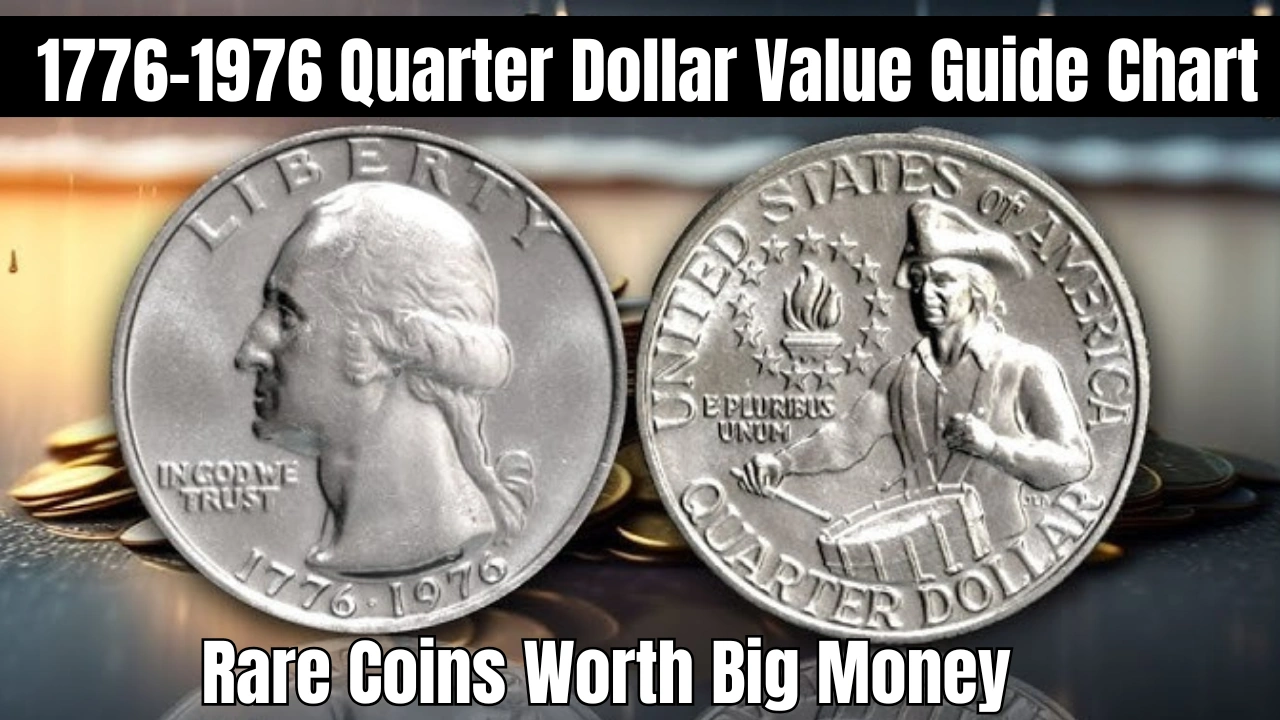
The 1976 Quarter Dollar Value still surprises collectors and casual coin hunters today. Even though these Bicentennial quarters were produced in large numbers, certain versions of the coin are worth more than you might think. If you have one in your coin jar, it might be time to take a second look. The double date 1776–1976 and the iconic drummer boy design make this coin stand out, but not all of them carry the same value.
Understanding the 1976 Quarter Dollar Value starts with knowing what sets some of them apart. From rare silver versions to unusual minting errors and high-grade proofs, there are specific details that can make a common quarter turn into a valuable collectible. This guide will help you recognize those rare versions and give you insight into how much they could be worth today.
1976 Quarter Dollar Value and What Makes It Special
So, what really affects the 1976 Quarter Dollar Value? It comes down to three things: where it was minted, what it is made of, and whether there are any unique errors or conditions that set it apart. While most Bicentennial quarters were struck for everyday use and are still only worth face value, others were made in special collector versions using 40 percent silver. These coins, often proof or uncirculated, were not released into general circulation. That alone can make them more valuable.
Then there are the rare mint errors, like double die quarters or those struck off-center. Combine any of those factors with a coin in excellent condition, and you might be looking at a small fortune. Below, we will break down each type, show you what to look for, and help you figure out if the quarter you are holding is just another coin or something truly special.
Overview Table: 1976 Quarter Dollar Value Guide at a Glance
| Coin Type or Feature | Estimated Value Range |
| Clad quarter (Philadelphia) | $0.25 |
| Clad quarter (Denver) | $0.25 |
| Uncirculated clad quarter | $1 to $5 |
| Silver uncirculated quarter | $4 to $10 |
| Silver proof quarter | $8 to $15 |
| High-grade silver proof | $20 to $100+ |
| Double die error quarter | $50 to $300+ |
| Off-center strike | $30 to $100+ |
| Clipped planchet quarter | $40 to $150+ |
| Silver planchet error (very rare) | $1,000 to $3,000+ |
Understanding the 1776–1976 Quarter
The Bicentennial quarter is more than just a coin. It was a symbol of America’s 200th birthday, and the U.S. Mint gave it a one-of-a-kind design for the occasion. Gone was the traditional eagle; instead, the reverse featured a colonial drummer boy surrounded by a ring of stars. Every Bicentennial quarter carries the dual date “1776–1976,” even though they were only minted in 1975 and 1976.
Three versions of this quarter were produced: a copper-nickel clad coin for general circulation, and two 40 percent silver collector’s coins, one in proof and one in uncirculated form. The silver coins were only made at the San Francisco Mint and were sold in special sets. If your coin has an “S” mint mark, it might be one of these special issues.
Rare Bicentennial Quarters Worth Big Money
Only a small number of 1776–1976 quarters are actually rare, but the ones that are can bring in serious money. Among the most valuable is the silver planchet error, where a standard circulation quarter was accidentally struck on a 40 percent silver blank. These are incredibly hard to find and can sell for thousands depending on their condition.
Other examples of high-value Bicentennial quarters include:
- Double die coins with clear doubling on the date or lettering.
- Off-center strikes, especially if the date is still visible.
- Clipped planchet coins where part of the metal is missing, creating a crescent-like gap.
Collectors will pay a premium for these coins, especially if they are in top condition and verified by a professional grading service.
High-Grade and Deep Cameo Proof Coins
Condition always plays a big role in value, and that is especially true for the 1976 Quarter Dollar Value. Proof coins, particularly those with a deep cameo finish, are worth more than standard circulation coins. These coins have frosted designs and mirror-like backgrounds, making them visually stunning.
If you happen to find a Bicentennial quarter that looks unusually shiny or detailed, it might be a proof coin. Proofs were not made for spending and were sold directly to collectors. A deep cameo silver proof in pristine condition can be worth well over $100.
How to Identify Valuable Bicentennial Quarters
Here is what to look for if you want to spot a valuable Bicentennial quarter:
- Edge color: Silver coins are solid silver-colored on the edge. Clad coins show a copper stripe.
- Mint mark: Philadelphia has no mint mark, Denver has a “D”, and San Francisco coins have an “S”. Only San Francisco made the silver versions.
- Weight: Silver coins weigh slightly more (around 5.75 grams). Clad coins weigh 5.67 grams.
- Error details: Look closely at the date, lettering, and drummer’s sticks for signs of doubling or misalignment.
- Condition: Coins with strong luster, no wear, and sharp detail are always worth more.
Keep a magnifying glass or coin loupe handy. Many valuable features are small and hard to see with the naked eye.
Most Valuable Bicentennial Quarter Varieties
- Silver Planchet Error Quarters
Accidentally struck on silver blanks intended for proof sets. Extremely rare and worth thousands if verified. - Double Die and Off-Center Errors
Coins showing clear doubling or major off-center strikes are highly collectible. Value depends on severity and condition.
FAQs
Q1: Are Bicentennial quarters still in circulation?
Yes, many are still found in everyday change, especially the copper-nickel clad versions from Philadelphia and Denver.
Q2: How can I tell if my 1976 quarter is silver?
Check the edge. If it does not show a copper stripe and appears silver all around, it may be a 40 percent silver version.
Q3: Are all 1976 quarters with an “S” mint mark silver?
Not all. Some “S” mint mark quarters are clad proof coins. You need to weigh the coin or check the edge to be sure.
Q4: Can I sell a rare 1976 quarter online?
Yes, many valuable Bicentennial quarters are sold on platforms like eBay or through coin dealers. Be sure to get it authenticated first.
Q5: What makes a 1976 quarter proof coin valuable?
Proof coins in high-grade condition, especially deep cameo versions made of silver, can be worth much more due to their quality and rarity.

